
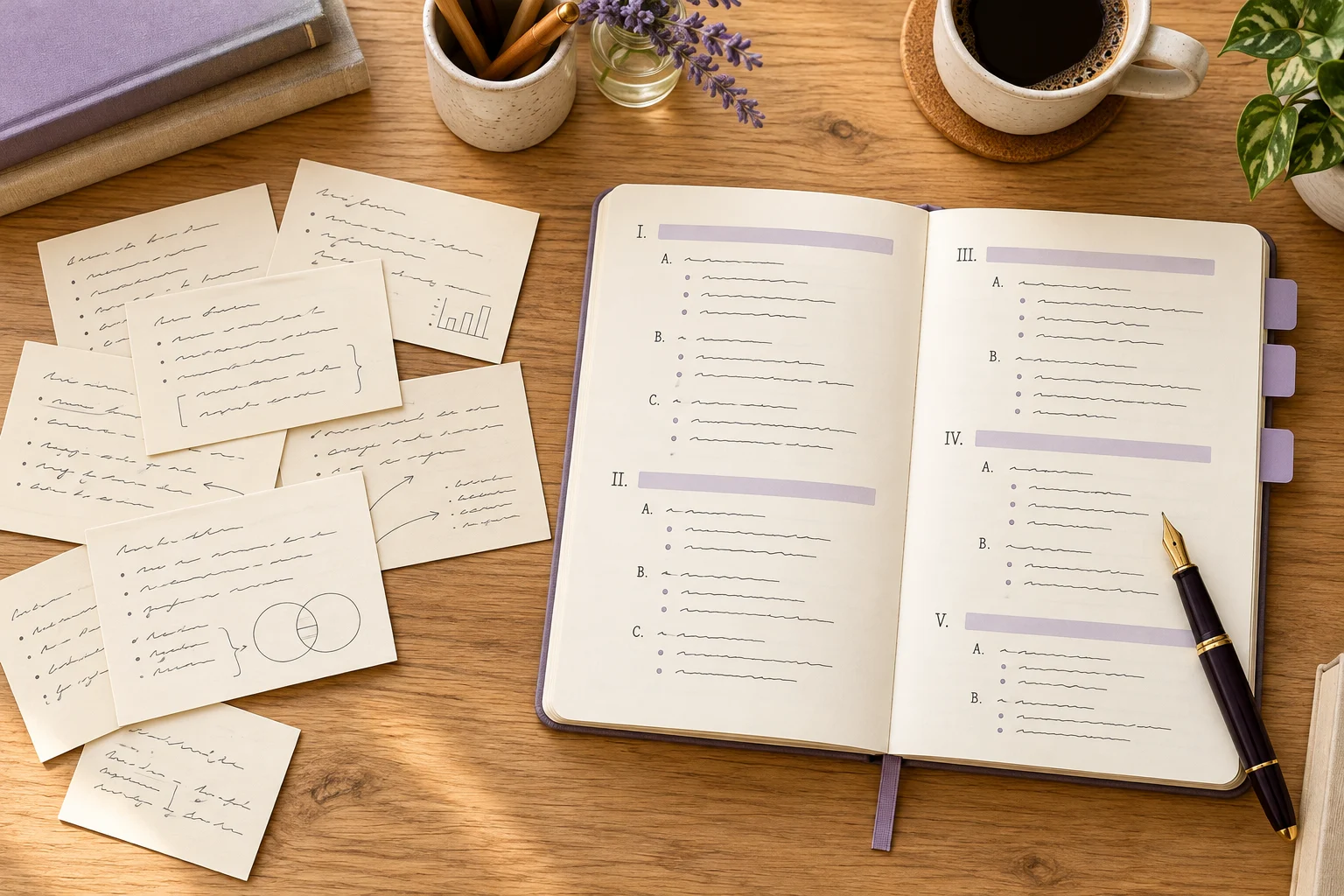
To turn research notes into a paper outline, group the notes by the question they help answer, give each group a provisional claim, and attach the relevant sources beneath it. Then arrange the claims in an order a reader can follow. Keep unanswered questions visible so that a neat outline does not hide missing evidence.
This guide walks through that process using a hypothetical college assignment about campus library hours. You can use the same worksheet for a course paper built from readings, interviews, or other material your assignment allows.
Start with the assignment and one focused question
Before sorting notes, write down the assignment’s purpose, length, required source types, and citation style. A short argumentative essay and an empirical research report need different structures. Use your instructor’s required format when one is provided.
For our teaching example, imagine an argumentative course paper asking: Should a campus library extend its hours during finals week? This is a hypothetical planning exercise, not a claim about any real university. All the source descriptions below are placeholders for material a student would need to locate and evaluate.
If your question is still broad, begin with this guide to choosing an argumentative essay topic. A narrower question makes it easier to decide which notes belong in the paper.
Make each note traceable before you reorganize it
A sentence copied into a notes document can lose its context quickly. Beside each useful note, record the source title or author, a link or reference, and the page or section where you found it. Mark whether the note is a quotation, a paraphrase, or your own interpretation.
You do not need an elaborate database. A small table is enough:
| Note | Source and location | Possible role | Status |
|---|---|---|---|
| Some students may lack quiet study space at home. | Student survey to locate; record question wording and sample. | Explain who might benefit. | Needs evidence |
| Additional hours could require additional staffing. | Library staffing policy or cost estimate to obtain. | Evaluate feasibility. | Needs evidence |
| Late-night demand may differ from daytime demand. | Hourly entrance counts to request, if available. | Identify useful opening hours. | Needs evidence |
| A limited trial might be easier to evaluate than a permanent change. | Writer’s proposed approach. | Develop a recommendation. | Own reasoning; test against findings |
The status column matters. A plausible idea is not yet a finding. If your current notes resemble this table, part of the next step is research, not drafting confident statements.
Group notes by the job they do in your argument
Put related notes together, even when they come from different readings. For the library question, useful groups might be student need, actual demand, operating constraints, and ways to evaluate a trial.
Purdue OWL’s outline guidance describes grouping and ordering ideas before turning them into headings. For this exercise, give each group a label that explains its purpose rather than naming a source.
A heading such as “Article 1” tells you where information came from. A heading such as “Which students would benefit from later access?” tells you why that information belongs in the paper.
Keep an unused-notes section. Saving a source does not obligate you to include it. A note about the library’s building design, for instance, may be interesting but irrelevant unless it affects the proposed opening arrangement.
Worked example: turn four note groups into a provisional outline
Here is an original planning outline for the hypothetical library assignment. Its claims remain conditional because we have not collected evidence.
- Introduction: define the decision. Explain the proposed change and who it would affect. State a tentative position, such as considering a limited finals-week trial if demand and staffing evidence support it.
- Student need: identify the access problem. Use relevant evidence to explain which students lack suitable alternatives. Avoid treating one student’s experience as representative of everyone.
- Demand: test whether later hours address that problem. Compare the hours students request with actual usage information, where available. Note differences between stated preferences and observed behavior.
- Feasibility and counterargument: examine the trade-off. Consider staffing, cost, and other constraints supported by sources. Explain what the strongest objection would change about the proposal.
- Recommendation: define a decision rule. Describe what evidence would justify a trial and what outcomes would inform a later decision. Keep proposed evaluation criteria separate from results that have already been measured.
- Conclusion: answer within the evidence. Return to the question and explain the limits of the recommendation. If the evidence is insufficient, say what remains unresolved.
Notice the sequence: need, demand, feasibility, decision. The same headings would not fit every topic. A history paper might use a chronological structure; a methods comparison might organize around evaluation criteria.
The UW–Madison Writing Center recommends organizing a paper around the writer’s points while treating the outline as a flexible guide. Change your plan when your reading changes the argument.
Connect sources inside each section
For every body section, identify what each source contributes. One may establish a background fact, another may challenge your interpretation, and a third may reveal a limitation. Those roles help you write a discussion rather than a stack of unrelated summaries.
Purdue OWL’s explanation of synthesis distinguishes finding relationships among sources from merely summarizing them. In the library example, a preference survey and entrance counts could answer different questions; disagreement between them would need explanation.
Try writing a short note beneath each heading: “These sources belong together because…” If you cannot finish it, the section may need a clearer question or a different set of notes.
Copy this section-planning template
Repeat the following block for each main section. Replace every bracketed instruction with your own material.
Section heading: [The question or claim this section addresses]
Purpose: [How this section helps answer the paper's main question]
Provisional claim: [What you currently think the evidence supports]
Evidence 1: [Source, page or section, and relevant note]
Evidence 2: [Source, page or section, and its relationship to Evidence 1]
My analysis: [The connection or interpretation I need to explain]
Counterargument or limitation: [What could weaken this claim]
Missing evidence: [The specific question I still need to investigate]
Transition: [Why the next section follows]
A source slot is a reminder to check evidence, not permission to invent a reference. When you paraphrase material, preserve its meaning and keep its citation attached. Our guide to citing paraphrased content explains that next step.
Use AI to propose structure, then check the result
If your course permits AI assistance, you can ask a writing assistant to suggest groups for notes you provide. Give it a constrained task: organize existing material, retain source labels, and flag gaps. Review the suggestions against your actual readings.
Using only the notes below, propose an outline for my research question.
Keep each note's source label and page reference attached.
Group notes by the question they answer, and explain the proposed order.
Label claims without supporting notes as NEEDS EVIDENCE.
Do not add studies, quotations, statistics, or references.
Show disagreements and limitations instead of smoothing them away.
This is a suggested prompt, not a guarantee that an AI tool will follow every instruction. Compare its output with the notes before drafting. You can open the towrite writing workspace to continue organizing and developing your paper.
Check the outline before writing full paragraphs
- Does every main heading help answer the research question?
- Can you distinguish sourced evidence from your own interpretation?
- Are missing sources and unanswered questions still visible?
- Have you included relevant disagreement or a serious counterargument?
- Does the order make sense when you read only the headings?
- Does the plan fit the assignment’s length and required structure?
Begin drafting a section whose evidence you understand. Return to research when a gap affects the argument, and revise the outline as your thinking develops.
Prepared with AI assistance for towrite.ai. The library scenario is a hypothetical teaching example. Check your sources and follow your course’s rules for AI use.